
The Skilled Trades Boom: Why Diesel Mechanic Careers Are Outpacing College Degrees in 2026
Key Takeaway: The diesel mechanic field is projected to add thousands of jobs through 2032, with starting salaries that rival many four-year degree holders — and without the student loan burden. For career changers and young adults weighing their options, skilled trades offer one of the clearest paths to stable, well-paying work in 2026.
Somewhere between the third career aptitude quiz and the fifth LinkedIn article about “future-proof skills,” most people forget that the economy still runs on physical things. Trucks move freight. Diesel engines power construction sites, hospitals, and data centers. And the people who keep those machines running are in critically short supply.
While the national conversation fixates on AI, remote work, and the tech sector, a quieter revolution is unfolding in skilled trades — and diesel mechanics are at the center of it. The numbers tell a story that college admissions offices would rather you didn’t hear: the diesel technician shortage is worsening, salaries are climbing, and the barrier to entry is a fraction of what a four-year degree costs.
The Numbers That Should Change How You Think About Careers
The Bureau of Labor Statistics projects that diesel service technician and mechanic positions will grow steadily through 2032, with approximately 28,000 job openings each year. That’s not aspirational forecasting — that’s replacement demand. The existing workforce is aging out faster than new technicians are entering the field.
The median annual wage for diesel technicians already sits above $58,000 nationally, with experienced technicians in fleet operations and specialized diagnostics regularly earning $75,000 to $95,000. Master technicians with manufacturer certifications in high-demand regions push well past six figures. Compare that to the median starting salary for bachelor’s degree holders across all fields — roughly $60,000 — and the math starts to look very different when you subtract $30,000 to $100,000 in student loan debt from one side of the equation.
The training timeline reinforces the advantage. Most diesel technology programs run 12 to 24 months. Apprenticeships let you earn while you learn. And unlike many degree-dependent careers where entry-level positions require “3-5 years of experience” (the great paradox of modern hiring), diesel shops are actively recruiting graduates on day one.
Why the Shortage Keeps Getting Worse
The diesel technician shortage isn’t new, but several converging forces are making it more acute in 2026.
First, the generational shift. A significant portion of the current diesel workforce entered the trade in the 1980s and 1990s. They’re retiring, and decades of cultural messaging that funneled students toward four-year universities left a gap in the pipeline. High schools largely dismantled shop classes and vocational training programs starting in the 1990s, and we’re paying for that decision now.
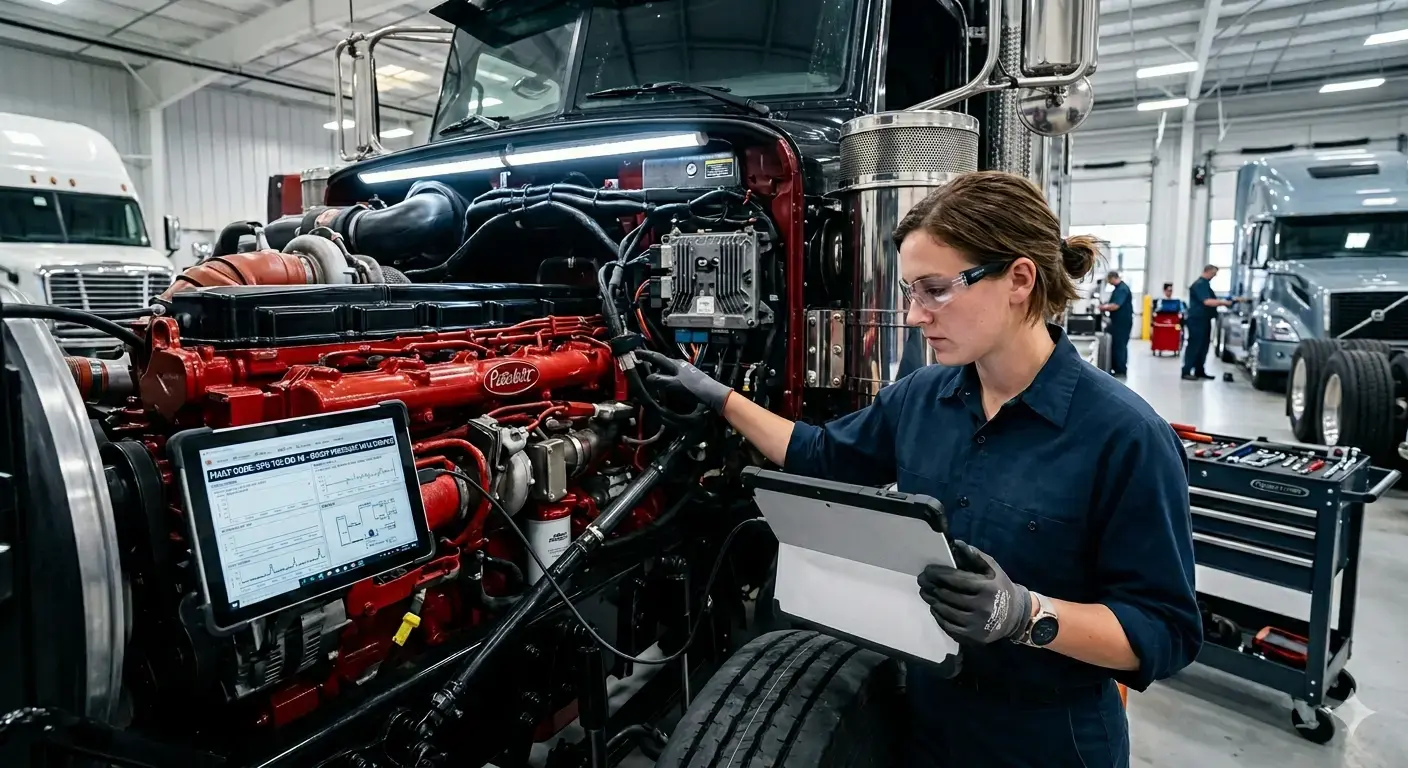
Second, technology has evolved dramatically. Modern diesel engines are computer-controlled systems with complex emissions aftertreatment, telematics integration, and electronic diagnostics that rival anything in the automotive world. The days of shade-tree mechanic work are long gone. Today’s diesel technician needs to be comfortable with
diagnostic scan tools, CAN bus protocols, and software-driven troubleshooting. Resources like diesel engine troubleshooting guides for fleet professionals have become essential reading for technicians who want to stay current with evolving powertrain technology.
Third, the freight economy keeps growing. E-commerce has permanently elevated shipping volumes. Even as electric vehicles gain traction in the passenger car market, commercial trucking remains overwhelmingly diesel-powered — and will be for decades. The 12+ million commercial trucks on American roads today all need maintenance, and the technicians who service them have extraordinary job security.
What a Diesel Mechanic Career Actually Looks Like
If your image of a diesel mechanic is someone lying in mud under a broken truck, it’s time for an update. The profession has evolved into a technology-driven career with multiple specialization paths and clear advancement opportunities.
Entry-level technicians start with preventive maintenance work: oil changes, filter replacements, brake inspections, and tire service. This is where you build foundational mechanical skills and learn how commercial vehicles are constructed. Starting pay typically ranges from $38,000 to $48,000 depending on your market.
Mid-career technicians with ASE certifications and a few years of experience move into diagnostic and repair work: engine overhauls, transmission rebuilds, emissions system troubleshooting, and electrical diagnostics. This is where earnings jump to the $60,000–$85,000 range, and where specialization begins to matter.
Senior and master technicians who hold manufacturer-specific certifications (Cummins, Detroit Diesel, PACCAR) and specialize in complex systems command the highest wages. Many transition into fleet maintenance management, service writing, technical training, or shop ownership — roles where they leverage their technical expertise into leadership positions.
One path that’s exploding in popularity is mobile diesel repair. Owner-operators who invest in a service truck and build a client base of local fleets can earn $100,000 or more annually while setting their own schedules. The startup cost for a mobile operation is a fraction of a traditional brick-and-mortar shop.
How to Get Started (Even If You Have Zero Experience)
The entry ramp into diesel mechanics is more accessible than most people assume. Here are the most common pathways:
- Community college or vocational programs. Most run 12–24 months and include hands-on lab work with actual commercial vehicles. Tuition typically ranges from $5,000 to $20,000 — a fraction of a four-year degree.
- Manufacturer-sponsored training. OEMs like Cummins, Peterbilt, and Daimler Trucks run training partnerships with technical schools that offer accelerated paths to manufacturer certification.
- Apprenticeships. Fleet maintenance operations and large repair shops offer paid apprenticeship positions where you earn while learning under experienced technicians.
- Military transition. Veterans with military vehicle maintenance experience transition naturally into civilian diesel careers, and many employers actively recruit from this talent pool.
Regardless of which path you choose, ASE (Automotive Service Excellence) certification is the industry benchmark that validates your skills to employers. The heavy-duty truck series covers eight specialty areas, and each certification you earn increases your market value and credibility.
The Technology Factor: This Isn’t Your Grandfather’s Wrench-Turning Job
One of the biggest misconceptions about diesel mechanics is that it’s purely physical labor. In reality, modern diesel repair is as much about data interpretation as it is about turning wrenches.
Fleet operations now rely on telematics systems that monitor engine performance, predict maintenance needs, and generate diagnostic data in real time. Technicians use manufacturer-specific software to reprogram engine control modules, perform forced DPF regenerations, and calibrate emissions systems. The industry even provides free fleet management tools and calculators that help technicians and managers track maintenance costs, decode fault codes, and optimize service schedules.
For people who enjoy problem-solving and technology but don’t want to spend their days staring at a screen, diesel repair offers a compelling hybrid: you get to work with your hands and your brain, solving real problems that keep the supply chain moving.
Is This Career Change Right for You?
Diesel mechanics isn’t for everyone, and it’s worth being honest about what the work demands. You’ll be on your feet. You’ll get dirty. Summer shop temperatures can be brutal, and winter roadside calls aren’t glamorous. But if you’re the kind of person who gets satisfaction from diagnosing a problem, fixing it, and seeing the tangible result of your work drive away — there are few careers that deliver that feeling as consistently.
The career is especially worth considering if you’re currently in a field affected by automation anxiety, carrying student debt that outpaces your earning power, or simply looking for work that feels more essential and less abstract. The trucking industry literally keeps the country running, and the people who maintain that equipment are valued accordingly.
The Bottom Line
The skilled trades boom isn’t a trend — it’s a correction. For decades, the default career advice was “go to college,” regardless of aptitude, interest, or market demand. The result is a generation of over-credentialed, under-employed graduates and a critical shortage of people who can actually fix the machines that keep the economy running.
Diesel mechanic careers offer something increasingly rare in the modern job market: clear demand, rising wages, multiple advancement paths, and work that can’t be outsourced or automated away. Whether you’re 18 and deciding between college and trade school, or 40 and ready for a career that trades cubicle politics for tangible problem-solving, the heavy-duty industry is hiring — and it’s not slowing down.
Author: Michael Nielsen, HeavyDutyJournal.com
Bio: Michael Nielsen is the Editor & Publisher of Heavy Duty Journal – heavydutyjournal.com, a digital trade publication serving diesel technicians, fleet managers, and owner-operators. With 15+ years of hands-on diesel repair and shop operations experience, he provides free expert guidance on commercial vehicle maintenance, fleet management, and trucking industry careers.