Truck Load Optimization: Where Supply Chains Quietly Lose (or Win) Millions
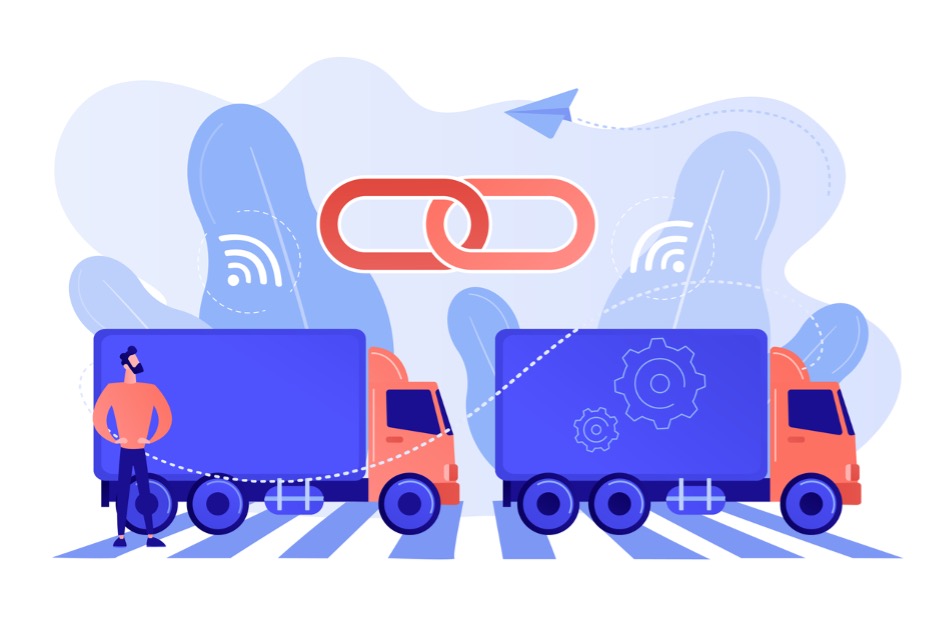
Source: Freepik
In many B2B supply chains, the biggest cost leak isn’t where you’d expect. It’s not procurement or warehousing. It’s what happens right before a truck leaves the dock. Truck load optimization is often treated as a detail. In reality, it’s a margin lever.
Picture this. You pay for a full truck but only use 70% of its capacity. The remaining 30% still costs you money. Across industries, trucks routinely leave at 60 to 80% utilization. That gap translates into unnecessary shipments, higher fuel consumption, and wasted labor.
A simple example helps. A company shipping 20 truckloads daily at 70% utilization could reduce that to 14 loads at full efficiency. Even reaching 90% means fewer trucks on the road every day.
Takeaway: If your trucks aren’t close to full, your margins are leaking with every shipment.
The Real Cost of Inefficient Truck Load Planning
Where does the money actually disappear?
Paying for Empty Space
Loads often look full but hide unused vertical space. Poor stacking decisions alone can waste 15 to 30% capacity.
Too Many Shipments
Weak truckload planning leads to fragmented shipments. Orders that could travel together are split, increasing handling, admin work, and delivery risk.
Fuel and Maintenance Waste
Poor weight distribution increases fuel consumption and accelerates wear on tires, axles, and suspension.
Time Lost in Manual Planning
Planning a single load manually can take up to 45 minutes and still result in inefficiencies.
Takeaway: These issues don’t exist separately. They compound across your entire operation.
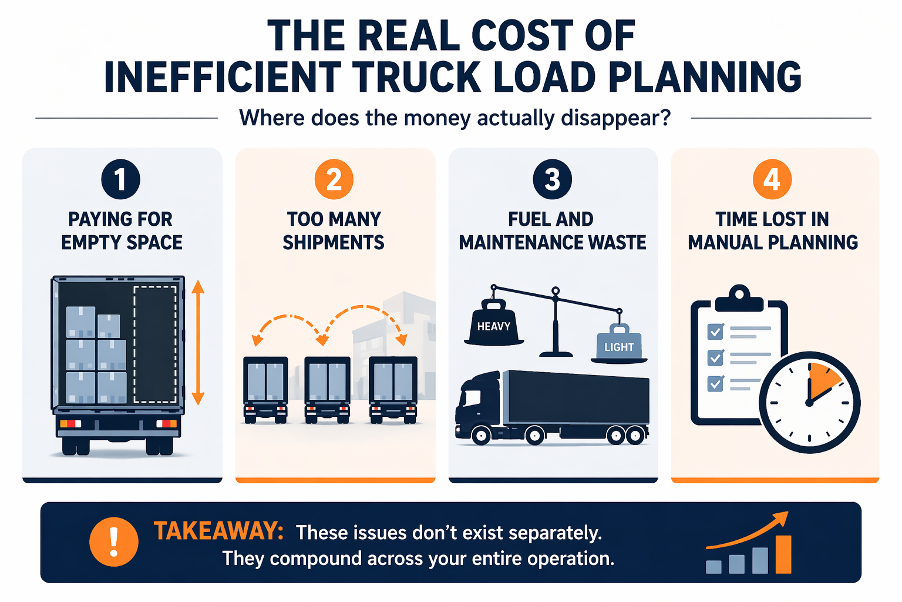
Infographic: AI generated
Why Manual Planning Breaks at Scale
Manual planning works at low volume. At scale, it fails.
Planners must juggle dimensions, weight, stacking rules, and delivery constraints. Even experienced teams simplify decisions under time pressure. They often optimize only floor space while ignoring vertical capacity.
A common audit finding is revealing. Even optimized manual loads leave 10 to 20% unused space due to missed stacking opportunities.
Expert tip: If your process depends on individual planner experience, results will vary, and inefficiency becomes systemic.
Takeaway: Human planning can’t consistently handle complexity at speed.
How Load Planning Software Changes the Game
Load planning software replaces estimation with calculation. It evaluates thousands of loading combinations in seconds.
What improves?
- Space utilization typically reaches 90 to 98%.
- Speed drops from 30 to 45 minutes to under 2 minutes.
- Consistency improves across all loads.
- Clarity increases through 3D visualization.
A Quick Comparison
| Approach | Avg. Utilization | Planning Time | Scalability |
| Manual planning | 60 to 80% | 30 to 45 min | Limited |
| Basic tools | 75 to 85% | 15 to 25 min | Moderate |
| Load planning software | 90 to 98% | under 2 min | High |
The shift is not incremental. It is operational.
Takeaway: Software changes both performance and predictability.
The Role of a Truck Loading Calculator
A truck loading calculator answers a key question. How much can actually fit into a truck?
Modern tools go further. They include weight limits, stacking rules, and product compatibility. This turns a simple estimate into a reliable plan.
A common mistake appears often. Companies rely on basic calculators that ignore real constraints. The result is a plan that fails in the warehouse.
Takeaway: Accuracy matters more than speed when planning loads.
Where the ROI Comes From
The return on truckload optimization builds from multiple small gains:
- Fewer trucks needed,
- Lower fuel costs,
- Less planning time,
- Reduced damage and delays.
Even a 10% improvement can deliver significant annual savings for mid-sized operations.
From Cost Center to Advantage
Efficient truckload planning affects more than cost.
- Lower emissions through fewer trucks
- More reliable deliveries
- Stronger operational image
In B2B environments, these factors increasingly influence partnerships.
If you want to see how modern tools approach this in practice, you can explore a real-world solution here, including 3D planning and automated optimization.
Takeaway: Optimization is no longer optional. It is competitive.
Final Thoughts: Stop Paying for Air
Every partially empty truck represents lost margin. Not once, but repeatedly.
Truck load optimization offers fast, measurable returns. The tools exist, and the impact is immediate. If your trucks leave at 70% capacity, you are not just moving goods. You are moving goods inefficiently.