
tvmountingus.com | How to Mount a Soundbar Under a Wall-Mounted TV: Wall, TV Mount or Shelf, and How Much Gap
The TV is on the wall and it looks right. Then the soundbar comes out of the box, and you hold it under the screen wondering whether it should hang from the wall, from the TV mount or sit on a shelf. In a Chicago two-flat with plaster walls, that choice also decides how many holes go into old, brittle plaster.
The short answer: a soundbar under a fixed TV usually goes on the wall with its own bracket, and one under a TV that swings or tilts goes on the TV mount, if the bar is light enough. A shelf works when you want no new holes near the screen. The gap comes from the soundbar maker, not from your eye. Here is how to choose for your bar, your TV and your wall.
Key takeaways
- Mount the TV first, then line the soundbar up with the center of the screen.
- A fixed TV pairs best with a soundbar on its own wall bracket.
- A TV that swings needs the bar on the TV mount, so the sound follows the screen.
- A bar with speakers on top needs a bigger gap than a plain one.
- Plug in the soundbar’s cables before it goes on the wall, and plan them with the TV’s.
How should a soundbar be mounted under a TV?
Ask two questions. Does the TV move, and is the bar light? A fixed TV takes the bar on its own wall bracket, screwed into studs where possible. A swinging or tilting TV takes a bracket on the TV mount, if the bar is within that bracket’s weight limit. Then leave the gap the soundbar maker asks for, the same at both ends.
How to choose a soundbar mount: five quick checks
1. Find out what kind of soundbar you have
Look in the box first. Many soundbars ship with a wall bracket and a paper template. Some are sold without one, and the maker sells a wall mount separately, as Sonos does for the Arc Ultra.
2. Weigh the soundbar
Find the weight in the manual or on the maker’s page. A light bar can hang from the TV mount. A heavy one belongs on its own wall bracket, with screws in the studs.
3. Look for speakers on top
Some soundbars have speakers that fire upward, toward the ceiling. They need open air above them, so they need a bigger gap under the TV. A plain bar with speakers only in front is less fussy.
4. Check the ports
Look at the back of the TV for an HDMI port marked ARC or eARC. That is where the soundbar cable goes. Then find the nearest outlet, because the bar needs its own power too.
5. Check whether your TV moves
A fixed or slightly tilting TV stays where it is. A full-motion TV swings out and turns. If it moves, a bar left on the wall ends up pointing at the empty side of the room.
Each soundbar method and what it needs
| Method | What it needs | Watch for |
|---|---|---|
| The soundbar’s own wall bracket | Screws into studs, or anchors suited to the wall | More holes, and the bar stays put when the TV swings |
| A bracket on the TV mount | A light bar and a TV mount with weight to spare | Low weight limits, and the bar adds to the mount’s load |
| A floating shelf | A shelf fixed solidly to the wall under the TV | The shelf shows, and it needs its own good fixing |
| A console or media cabinet | Furniture of the right height under the TV | The gap changes if the furniture moves |
Mounting the soundbar to the wall
This is the usual choice under a fixed TV. The bracket screws to the wall below the screen, and the bar hooks onto it. Samsung’s soundbar guide says to put the support screws into studs if possible, and to use anchors suited to the wall where there is no stud.
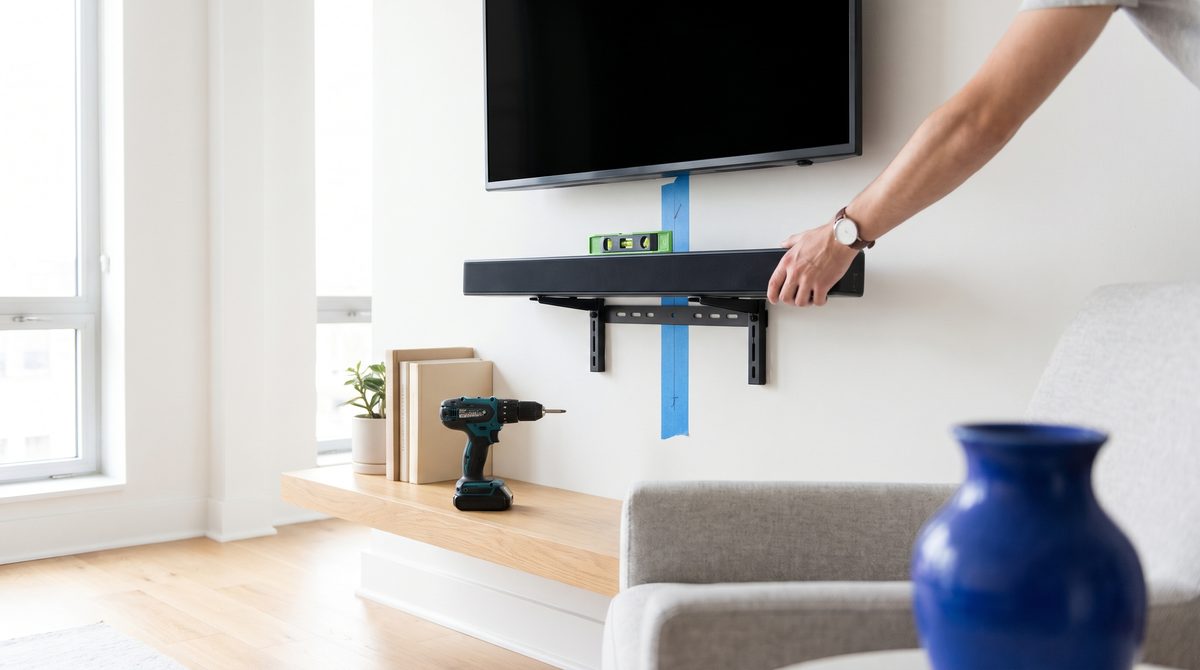
The catch is the holes. They have to sit level, centered on the TV, at the right gap, and you only get one good try on plaster. Work from the TV’s center line, not from the wall’s edges or the ceiling, because old Chicago walls and ceilings are rarely straight.
A heavy bar, or one with speakers on top, almost always belongs here. Our soundbar installation service mounts the bar centered under the TV, including under a TV that is already on the wall.
Mounting the soundbar to the TV mount
A bracket made for this clamps to the TV mount, and arms hold the bar below the screen. When the TV tilts or swings, the bar goes with it, and the sound stays aimed at the sofa.
The catch is weight. One universal bracket from Sanus is rated for soundbars up to 15 pounds. Its manual says the TV, the bar and the bracket together must stay under the TV mount’s own rating. A full-motion arm already pulls hard on the wall, so the bar adds to a load that is already working.
What works: a light bar on a mount with room to spare. If the bar is heavy, keep the TV fixed and put the bar on the wall instead.
Setting the soundbar on a shelf or console
A floating shelf under the TV holds the bar with no bracket at all. It is easy to change later, and it suits a renter or anyone who swaps soundbars often. A console or media cabinet does the same job without new holes.
The catch is that the shelf shows, and it needs its own solid fixing into studs or masonry. With furniture, the gap changes every time the cabinet shifts. If you rent, our post on mounting a TV in a Chicago rental apartment covers what to ask before drilling.
How much gap to leave under the TV
The soundbar maker sets the gap, and makers do not agree because their bars differ. Samsung’s guide asks for at least 2 inches below a wall-mounted TV. Sonos asks for at least 4 inches under its Arc Ultra, a bar with speakers on top.
Whatever the figure, keep it even from end to end. An uneven gap is the first thing anyone notices. Sonos also asks for about a foot of open space at each end of the bar, so check that in a narrow spot between built-ins.
Hiding the soundbar cables with the TV’s
A soundbar adds a power cable and an HDMI cable. Run them in the same route as the TV’s, so the wall below shows nothing. Our guide on how to hide TV wires covers cord covers, in-wall kits and routes behind furniture. HDMI made for in-wall use can go inside the wall. A power cord cannot.
Power is often the snag, because there may be no outlet near the bar. Our post on what to do with no outlet behind the TV walks through the options. A new outlet is a job for an electrician.
Chicago homes and the right soundbar setup
Bungalows and brick two-flats. Expect plaster on wood lath inside. Plaster is brittle, so the bracket screws go into studs, drilled slowly. Our post on mounting a TV on plaster walls explains how. On a brick wall, the anchors go into the brick, not the mortar.
Greystones and courtyard buildings. Walls can be plaster or brick, often uneven. A wall bracket set from the TV’s center line hides the lean better than a shelf does.
Condos and high-rises. Many have drywall on metal studs, or concrete. A bass-heavy bar on a hollow wall can carry sound next door, so an inside wall is kinder to neighbors. Concrete needs the building’s rules before anyone drills.
Suburban houses. Drywall on wood studs, the easiest wall for a soundbar bracket. Studs usually sit 16 inches apart, so a wide bar can often reach two of them.
Common questions
How far below the TV should a soundbar be mounted?
Follow the soundbar maker. Samsung asks for at least 2 inches. Sonos asks for at least 4 inches under an Arc Ultra, because its top speakers need room. Keep the gap the same at both ends.
Can you attach a soundbar to a TV wall mount?
Yes, with a bracket made for it, and the bar then moves with the TV. These brackets carry light bars only, and the total weight must stay under the TV mount’s rating. A heavy bar goes on the wall.
Should a soundbar go above or below the TV?
Below, in most rooms. Sonos calls below the TV the recommended spot for the Arc Ultra. It keeps the sound close to the picture and the bar near the TV’s cables.
Do you need a stud to mount a soundbar?
It is better to have one. Samsung says to use studs if possible, and anchors suited to the wall otherwise. On plaster, aim for studs, because plaster cracks easily. On brick, the anchors go into the brick itself.
Not sure how your soundbar should go up?
Text R&R TV Mounting your TV size, the soundbar model, your zip code and a photo of the wall under the TV. We reply with a free quote, and the more detail you send, the more accurate it will be.