Best Pens for Journaling: The Complete Buying Guide 2026
Picking up the wrong pen can ruin a good journaling habit. The ink smears under your palm. The line skips halfway through a sentence. The paper soaks through, and your thoughts bleed onto the next page. A journal should feel like a quiet place to think of Best Pens for Journaling: The Complete Buying Guide 2026. The right pen makes that easier. The wrong one makes you dread opening the notebook at all.
The Quick Answer: Best Pens for Journaling
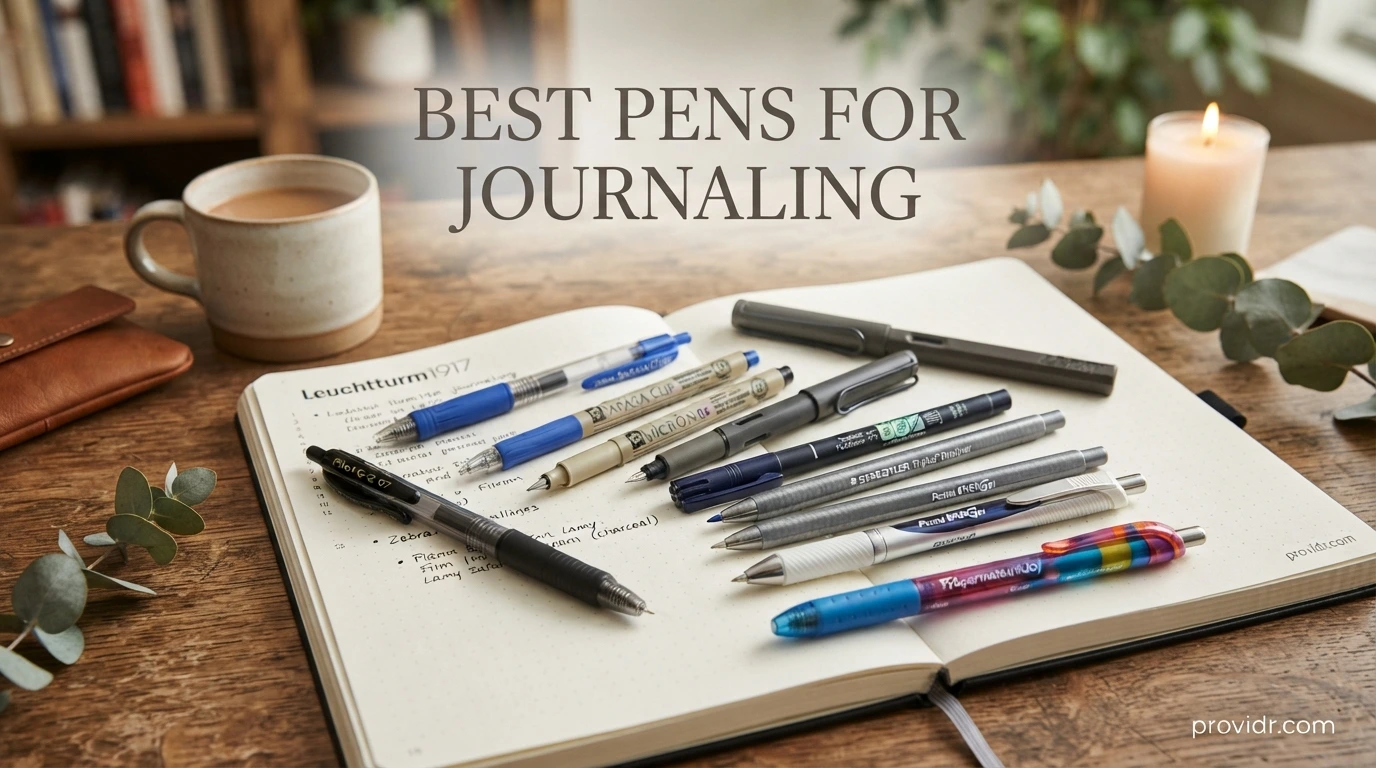
If you want one answer right now, here it is. The Pilot G2 07 is the best all-around pen for journaling. It writes smoothly, dries fast enough for most paper, and costs very little. For no-bleed, archival-quality writing, choose the Sakura Pigma Micron. For a smooth, buttery gel feel with less bleed, try the Uni-ball Signo DX. For fountain pen lovers, the LAMY Safari is the most reliable starter fountain pen for journaling.
Below, you’ll find the reasoning behind these picks, plus dozens more options sorted by ink type, budget, hand type, and journaling style.
Why the Right Journal Pen Matters
A pen is not just a writing tool. It shapes how your journal looks and feels years from now.
A smooth pen keeps your hand relaxed. A scratchy or dry pen makes your handwriting tense and uneven. Ink that bleeds through thin paper ruins two pages at once. Ink that fades over time erases memories you meant to keep. And a pen with bad grip comfort can leave your hand sore after just one long session.
Journaling is personal. Your pen should match your handwriting size, your dominant hand, your paper, and your purpose. A bullet journal artist has different needs than someone writing a quick gratitude list before bed.
Key Factors to Consider When Choosing a Journal Pen
Ink Type
The ink type is the biggest factor in how your pen performs.
- Gel ink flows smoothly and comes in bold, saturated colors. It dries a bit slower than ballpoint ink but writes with almost no pressure.
- Ballpoint ink is oil-based. It dries fast and rarely bleeds, but the line can feel dry or scratchy on cheap paper.
- Rollerball ink sits between gel and fountain pen ink. It’s liquid, so it flows freely, but this also means more bleed-through risk on thin paper.
- Fountain pen ink is liquid and the smoothest of all. It needs quality paper to perform well and takes longer to dry.
- Fineliner ink (like the Sakura Pigma Micron) uses pigment-based ink through a felt tip. It’s the top choice for no-bleed line work, sketching, and lettering.
Tip Size
Tip size changes how your handwriting looks and how much detail you can add.
- Fine (0.5mm–0.7mm): Best for dense note-taking and small handwriting.
- Medium (0.7mm–1.0mm): Good all-purpose size for daily journaling.
- Extra-fine (0.28mm–0.38mm): Ideal for planners, tiny bullet journal boxes, and detailed sketching.
- Bold (1.0mm+): Great for headers, titles, and bullet journal spreads that need visual weight.
Writing Smoothness and Grip Comfort
A smooth pen glides without pressing hard into the page. This matters most during long journaling sessions. Look for a barrel with a soft rubber grip if you write for more than a few minutes at a time. A hard plastic grip can cause hand fatigue quickly.
Drying Time and Smudge Resistance
Slow-drying ink smudges under your palm, especially if you’re left-handed and drag your hand across fresh writing. Gel and fountain pen inks dry slower than ballpoint. If you smudge often, choose a quick-dry gel pen or a ballpoint.
Bleed-Through, Ghosting, and Feathering
These three problems ruin journal pages.
- Bleed-through happens when ink soaks completely through the page, visible on the other side.
- Ghosting is a faint shadow of your writing showing through, even without full bleed.
- Feathering happens when ink spreads out along paper fibers, making lines look fuzzy instead of crisp.
Thin, low-GSM paper makes all three worse. Fountain pens and rollerballs are most likely to cause them. Fineliners and ballpoints cause the least.
Waterproof and Archival Qualities
If you want your journal entries to last for decades without fading, look for archival, pigment-based ink. Sakura Pigma Micron and many fineliners are archival and waterproof, which matters for scrapbooking, Bible journaling, and mixed-media pages that use watercolor.
Refillability and Durability
Refillable pens save money and reduce waste over time. Brands like Pilot, Zebra, and LAMY sell refill cartridges, so you don’t have to throw out the whole pen once the ink runs dry.
How Paper Thickness (GSM) Affects Pen Performance
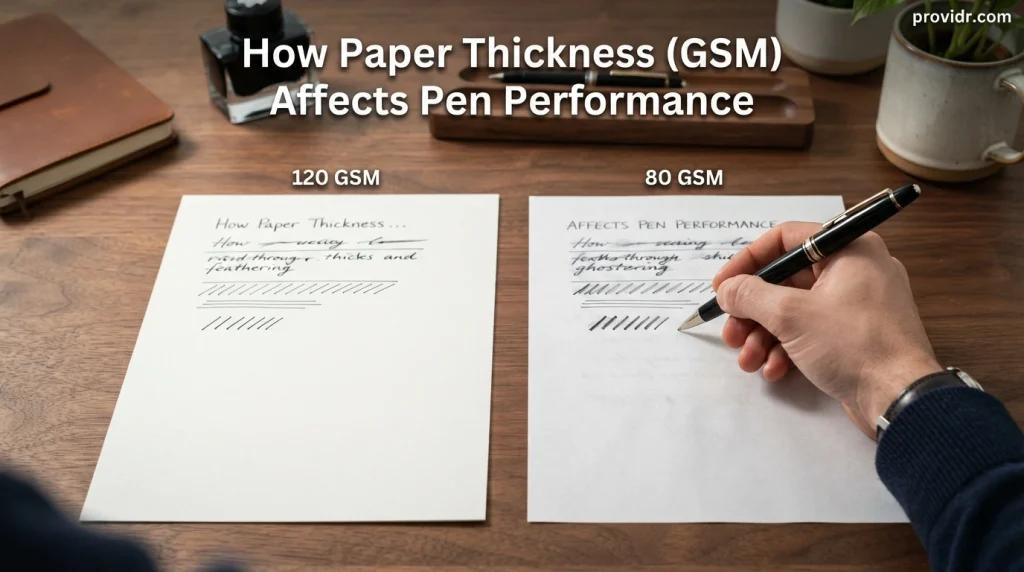
GSM stands for grams per square meter. It measures paper thickness and weight.
| Paper GSM | Best For | Pens That Work Well |
| 60–80 GSM (standard notebook paper) | Everyday writing, budget journals | Ballpoint, fine gel pens, fineliners |
| 90–100 GSM (mid-weight journal paper) | Bullet journals, planners | Gel pens, rollerballs, fine fountain pens |
| 120–160 GSM (thick journal paper) | Fountain pens, watercolor, mixed media | Fountain pens, brush pens, gel pens |
| 200+ GSM (art paper, sketchbooks) | Calligraphy, ink washes, Bible journaling | Fountain pens, fineliners, brush pens |
If you use a thin notebook, stick to ballpoint or fine-tip gel pens. Save your fountain pens for thicker, fountain-pen-friendly paper like Tomoe River, Rhodia, or Leuchtturm1917.
Read More: https://providr.com/why-the-worlds-biggest-industries-refuse-to-move-on-from-legacy-tech/
Best Pens for Journaling by Brand: Detailed Reviews
Sakura Pigma Micron
The Pigma Micron is the gold standard for no-bleed, archival journaling. It uses pigment-based ink that dries almost instantly and resists water and fading.
- Strengths: Zero bleed-through on most paper, archival quality, comes in multiple tip sizes (from 005 to 08), great for lettering and sketching.
- Weaknesses: Felt tip wears down with heavy pressure; not as smooth as gel ink for long writing sessions.
- Ideal for: Bullet journal line art, planner details, Bible journaling, scrapbooking, and anyone who wants entries to survive decades.
Pilot G2
The Pilot G2 is the best-selling gel pen in the world for good reason. It writes smoothly straight out of the box and comes in a huge range of colors and tip sizes.
- Strengths: Smooth gel flow, comfortable grip, refillable, widely available, affordable.
- Weaknesses: Can bleed through thin paper (under 80 GSM); slower drying time than ballpoint.
- Ideal for: Daily journaling, note-taking, students, and anyone who wants a reliable everyday pen.
Pilot Juice Up
The Juice Up is Pilot’s newer, more refined gel pen. The ink formula is thinner and smoother than the original G2, with less smearing.
- Strengths: Very smooth writing, quick-drying compared to standard gel ink, fine tip options down to 0.3mm.
- Weaknesses: Slightly pricier than the G2; less common in stores outside Asia.
- Ideal for: Detailed planner writing, small handwriting, and journalers who want gel smoothness with less smudge risk.
Pentel EnerGel
The EnerGel uses a liquid gel ink that dries fast, which makes it a favorite for left-handed writers.
- Strengths: Fast-drying, smooth liquid gel flow, comfortable grip, low smudge risk.
- Weaknesses: Can skip if stored horizontally for long periods.
- Ideal for: Left-handed journalers, fast note-takers, students.
Zebra Sarasa
The Sarasa is a budget-friendly gel pen with a huge color range and reliable performance.
- Strengths: Smooth, consistent ink flow, affordable, wide color selection, quick-drying “Clip-on” line.
- Weaknesses: Standard line can bleed on thinner paper.
- Ideal for: Colorful bullet journal spreads, budget-conscious journalers.
Uni-ball Signo DX
The Signo DX offers precise, needle-tip control with rich, saturated gel ink.
- Strengths: Fine, controlled lines, vivid colors, smooth flow, good for detail work.
- Weaknesses: Slower drying time; needle tip can catch on rough paper.
- Ideal for: Detailed bullet journal art, planners, and precise handwriting.
Muji Gel Pens
Muji’s minimalist gel pens are known for their light, effortless writing feel.
- Strengths: Extremely smooth, lightweight design, understated aesthetic that many journalers love.
- Weaknesses: Limited availability outside Muji stores; fewer color options than Pilot or Zebra.
- Ideal for: Minimalist journalers who value a clean, simple pen.
Paper Mate Flair
The Flair is a felt-tip pen, not a fineliner, so it lays down a bolder, softer line.
- Strengths: Bold, expressive line, smooth felt-tip glide, affordable, great for headers and titles.
- Weaknesses: Tip wears down over time; not ideal for tiny handwriting.
- Ideal for: Bullet journal headers, colorful to-do lists, expressive daily journaling.
Tombow Fudenosuke
This brush pen gives you calligraphy-style lines without the learning curve of a traditional brush pen.
- Strengths: Flexible tip for thick-and-thin strokes, two firmness options (hard and soft), great for lettering.
- Weaknesses: Needs practice for consistent calligraphy results; not meant for dense handwriting.
- Ideal for: Bullet journal titles, brush lettering, creative journal covers.
LAMY Safari
The LAMY Safari is the most recommended beginner fountain pen in the world, and for good reason.
- Strengths: Smooth nib, ergonomic grip section, refillable with cartridges or a converter, durable build.
- Weaknesses: Needs fountain-pen-friendly paper to avoid feathering; nib width isn’t adjustable without buying a new nib.
- Ideal for: Fountain pen beginners, daily journaling, calligraphy-curious writers.
Comparison Table: Gel vs Ballpoint vs Rollerball vs Fountain vs Fineliner
| Feature | Gel Pen | Ballpoint | Rollerball | Fountain Pen | Fineliner |
| Writing quality | Smooth, bold | Firm, controlled | Very smooth | Smoothest | Crisp, precise |
| Drying speed | Medium | Fast | Slow | Slowest | Fast |
| Smudge resistance | Medium | High | Low | Low | High |
| Bleed-through risk | Medium | Low | High | Medium-High | Very Low |
| Comfort for long writing | High | Medium | High | High | Medium |
| Maintenance needed | None | None | None | Regular cleaning | None |
| Price range | Low-Medium | Low | Medium | Medium-High | Low-Medium |
Best Pens by Journaling Style
Best Pens for Bullet Journaling
Bullet journalers need a mix of fine-tip precision and bold headers. A combination works best:
- Fine tip: Sakura Pigma Micron 01 or Pilot Juice Up 0.3mm
- Headers: Paper Mate Flair or Tombow Fudenosuke
- Everyday writing: Pilot G2 07
Best Pens for Daily Journaling and Gratitude Journals
You want smooth, comfortable, low-maintenance pens for daily use.
- Pilot G2 (smooth and affordable)
- Pentel EnerGel (fast-drying, good for quick entries)
- Zebra Sarasa (colorful and reliable)
Best Pens for Planners
Planners often have tight boxes and small text, so extra-fine tips work best.
- Pilot Juice Up 0.3mm
- Muji Gel Pens 0.38mm
- Uni-ball Signo DX 0.38mm
Best Pens for Sketching and Creative Writing
Sketchers and creative writers benefit from varied line weights and archival ink.
- Sakura Pigma Micron (multiple tip sizes in one set)
- Tombow Fudenosuke (for expressive strokes)
- LAMY Safari with a fine or medium nib
Best Pens for Bible Journaling
Bible journaling needs thin, no-bleed lines because Bible paper is extremely thin.
- Sakura Pigma Micron 01 or 005
- Zebra Mildliner (for highlighting without bleed, when paired with a fineliner for text)
Best Pens for Travel Journals
Travel journals get tossed in bags, so durability and leak resistance matter.
- LAMY Safari (durable body, cartridge convenience)
- Pilot G2 (reliable and replaceable if lost)
- Sakura Pigma Micron (no smearing in humid climates)
Best Pens for Left-Handed Journalers
Left-handed writers drag their hand across fresh ink, which causes smudging. The fix is choosing fast-drying ink.
- Pentel EnerGel: Dries quickly and glides smoothly.
- Zebra Sarasa Clip-on: A quick-dry gel formula built for this exact problem.
- Uni-ball Jetstream: A hybrid ink that combines ballpoint dryness with gel smoothness.
Avoid traditional fountain pens and standard rollerballs if smudging is a frequent problem, since their ink stays wet longer.
Read More: https://providr.com/from-security-clearance-to-cloud-success-exploring-aws-career-opportunities/
How Handwriting Size Affects Pen Choice
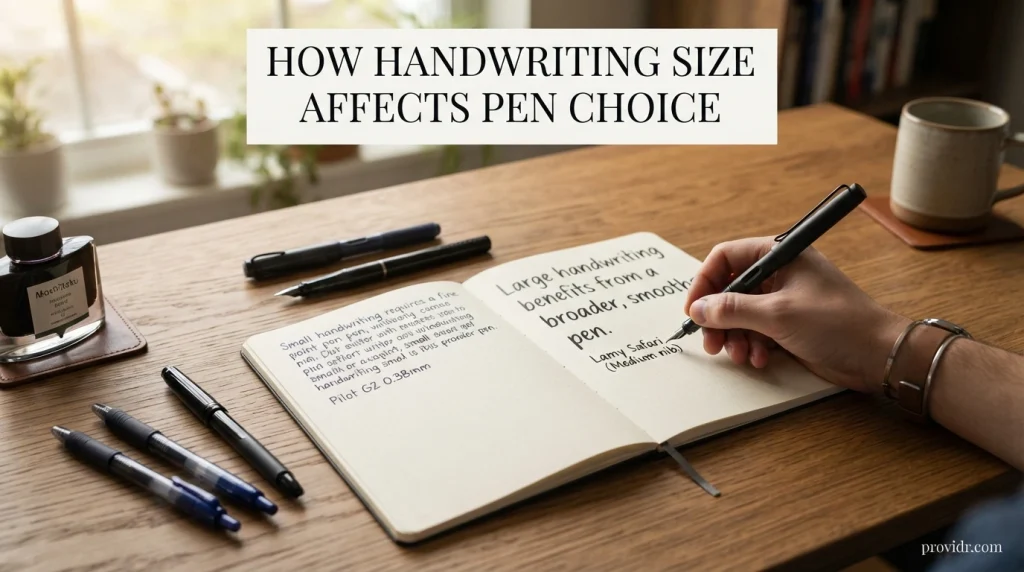
Small, tight handwriting needs a fine or extra-fine tip (0.28mm–0.5mm) to avoid ink pooling into blobs. Large, loose handwriting works well with medium or bold tips (0.7mm–1.0mm), since a fine tip can feel scratchy and slow when writing big letters quickly.
Common Mistakes Beginners Make When Choosing Journal Pens
- Buying a fountain pen before checking paper compatibility. Cheap notebook paper causes feathering and bleed with fountain pen ink.
- Choosing tip size based on looks, not handwriting size. A bold tip looks fun but can turn small handwriting into a smudgy mess.
- Ignoring drying time for left-handed writing. This leads to smeared pages and frustration.
- Skipping a pen test page. Always test a new pen on the actual notebook paper you plan to use before committing to it for daily journaling.
- Overspending before knowing your preferences. Start with affordable pens like the Pilot G2 or Pigma Micron before investing in higher-end fountain pens.
How to Prevent Smudging, Ghosting, and Bleeding
- Let ink dry for a few seconds before touching the page, especially with gel or fountain pen ink.
- Use a blotting sheet or scrap paper under your writing hand if you’re left-handed.
- Choose paper rated 90 GSM or higher if you use gel, rollerball, or fountain pens.
- Test a new pen on the back page of your notebook first.
- Store liquid-ink pens (rollerball, fountain) horizontally or nib-up to prevent leaks and drying out.
Pen Maintenance and Storage Tips
- Fountain pens: Rinse the nib with water every few weeks, especially when switching ink colors. Store upright or flat, never nib-down for long periods.
- Gel pens: Store horizontally to keep ink flowing evenly to the tip.
- Fineliners and felt tips: Always replace the cap fully after use. Left uncapped, the tip dries out within hours.
- Ballpoint pens: These need the least care and can be stored in any position.
When to Replace or Refill Your Pen
Watch for these signs:
- The line starts skipping or fading even with light pressure.
- The ink turns patchy or streaky.
- The tip feels scratchy compared to when it was new.
- You can see through the ink barrel and it’s clearly near empty.
Refillable pens (Pilot G2, Zebra Sarasa, LAMY Safari) let you replace just the ink cartridge, which is cheaper and more sustainable than buying a new pen every time.
Buying Tips for Every Budget
- Under $5: Pilot G2, Zebra Sarasa, Paper Mate Flair
- $5–$15: Pilot Juice Up multi-packs, Sakura Pigma Micron sets, Uni-ball Signo DX
- $15–$30: LAMY Safari fountain pen, Tombow Fudenosuke sets
- $30+: Higher-end fountain pens with gold nibs, limited-edition gel pen sets
You don’t need to spend a lot to get a great journaling experience. Many professional journalers and artists still reach for a $3 Pilot G2 every day.
Frequently Asked Questions
What is the best pen for everyday journaling? The Pilot G2 is the best all-around choice. It’s smooth, affordable, and works well on most notebook paper.
What pen doesn’t bleed through paper? The Sakura Pigma Micron rarely bleeds through, even on thinner paper, because of its pigment-based, fast-drying ink.
Is gel pen or ballpoint better for journaling? Gel pens write more smoothly and come in richer colors, but ballpoint pens dry faster and bleed less. Choose gel for comfort and ballpoint for reliability on thin paper.
What is the best fountain pen for beginners? The LAMY Safari is the most recommended beginner fountain pen because of its smooth nib, comfortable grip, and refillable design.
What pen is best for bullet journaling? A combination works best: a fineliner like the Sakura Pigma Micron for detail work and a bold felt-tip like the Paper Mate Flair for headers.
Which pens are best for left-handed writers? Fast-drying pens like the Pentel EnerGel and Zebra Sarasa Clip-on reduce smudging for left-handed journalers.
What GSM paper is best for fountain pens? Look for paper rated 100 GSM or higher. Notebooks like Leuchtturm1917, Rhodia, and Tomoe River are built for fountain pen ink.
Are gel pens archival quality? Most standard gel pens are not archival. If you want ink that resists fading and water damage, choose a pigment-based fineliner like the Sakura Pigma Micron.
How often should I replace my journal pen? Replace or refill your pen when the line starts skipping, fading, or feels scratchy, even under normal pressure. This varies by usage but typically happens every few months for daily journalers.
Can I use the same pen for planning and creative journaling? Yes, but a fine or extra-fine gel pen like the Pilot Juice Up works best for both, since it’s precise enough for small planner text and smooth enough for longer creative entries.
Final Recommendations
Choosing the best pen for journaling comes down to your handwriting, your paper, and your purpose.
- Best for beginners: Pilot G2. It’s affordable, smooth, and forgiving on most paper.
- Best for professionals and daily writers: Pilot Juice Up or Uni-ball Signo DX for precise, smudge-resistant writing.
- Best for students: Pentel EnerGel or Zebra Sarasa for fast note-taking without smudging.
- Best for artists and bullet journalers: Sakura Pigma Micron paired with Tombow Fudenosuke for line variety.
- Best for fountain pen lovers: LAMY Safari on fountain-pen-friendly paper.
There’s no single “best” pen for everyone. The best journal pen is the one that matches how you write, how hard you press, which hand you write with, and what kind of paper sits in your notebook. Start with an affordable option, test it on your actual journal pages, and adjust from there. Once you find the right match, journaling stops feeling like a chore and starts feeling like the smooth, satisfying habit it’s meant to be.