
Fractional COO: What It Is, When You Need One, and How to Hire the Right Fit
Your business is growing, but you’re drowning. Sales are up. The team is bigger. Yet somehow you’re still the one approving every invoice and fixing every process breakdown. Operations can’t run without you in the room, and you’re stuck staying up until midnight just to keep things moving.
This is one of the most common traps founders fall into. It’s also one of the most avoidable. You built a company to gain freedom. But the daily chaos of running it has taken that freedom away. Hiring a full-time Chief Operating Officer feels like the obvious fix. It isn’t. A full-time COO can cost $200,000 to $350,000 a year in salary alone. Most growing companies don’t have enough operational work to justify that price tag year-round.
This is exactly the gap a fractional COO fills.
In this guide, you’ll learn what a fractional COO does. You’ll see how the arrangement works in practice, what it costs, and how it compares to other options like consultants or full-time hires. You’ll also get a practical framework for choosing the right person, red flags to avoid, and answers to the questions founders ask most before making this decision.
What Is a Fractional COO?
A fractional COO is an experienced operations executive. They work with your company part-time, on a contract basis, instead of as a full-time employee. Typically, they work one to three days a week, or a set number of hours per month. Most split their time across two or more client companies.
The word “fractional” simply means you get a fraction of their time. It doesn’t mean a fraction of their experience. Most fractional COOs have already served as a COO, VP of Operations, or general manager somewhere else. Their past companies often range from startups to mid-sized businesses. They bring that same strategic and operational skill to you, just packaged into a part-time role.
In practice, a fractional COO does the same job a full-time COO would do. They turn strategy into execution. They build systems that let the business run without the founder’s constant involvement. They manage teams and processes. And they make sure the company actually delivers on what it promises customers. The real difference is cost, commitment level, and flexibility.
Why Businesses Hire a Fractional COO
Most companies bring in a fractional COO because of one core problem. The founder or CEO spends too much time on operations and not enough time on strategy, sales, or product.
Here are the situations that typically trigger this decision:
- Growth has outpaced systems. Revenue is climbing, but processes, hiring, and reporting haven’t kept up.
- The founder is the bottleneck. Every decision, big or small, still runs through one person.
- Teams are misaligned. Departments work in silos. Nobody owns execution across the business.
- Scaling feels chaotic. Adding new hires, locations, or product lines creates more confusion instead of more capacity.
- A full-time COO isn’t affordable yet. The company needs senior operational leadership but doesn’t have the budget for a six-figure full-time hire.
- Preparing for an exit, funding round, or acquisition. Investors and buyers want to see clean operations and a business that doesn’t depend entirely on the founder.
A fractional COO solves these problems without the long-term financial commitment of a full-time executive hire.
Read More: https://providr.com/from-security-clearance-to-cloud-success-exploring-aws-career-opportunities/
What Does a Fractional COO Actually Do?

The exact responsibilities shift based on company size and stage. Most fractional COOs focus on these core areas:
- Building and refining systems and processes. They create repeatable workflows for hiring, onboarding, fulfillment, customer service, and internal communication.
- Financial oversight and reporting. They work closely with finance to track KPIs, manage budgets, and improve profitability.
- Team leadership and structure. They clarify roles, improve accountability, and sometimes manage department heads directly.
- Strategic planning and execution. They turn the CEO’s vision into a concrete operating plan with milestones and deadlines.
- Technology and tools implementation. They introduce or improve software for project management, CRM, HR, and reporting.
- Vendor and partner management. They negotiate contracts, manage supplier relationships, and cut operational costs.
- Hiring and organizational design. They help decide what roles the company needs next, and in what order.
- Crisis and bottleneck resolution. They step in to fix whatever process is breaking under growth right now.
In short, a fractional COO owns the “how” of the business. That frees the CEO to focus on the “what” and “why.”
Signs You Need a Fractional COO
Use this quick checklist. Count how many apply to your business right now:
- You work more than 55–60 hours a week just to keep operations afloat
- Decisions bottleneck at your desk, even small ones
- Your team has no clear process for repeatable tasks
- You’ve grown revenue, but profit margins haven’t improved
- You miss deadlines or drop quality as you scale
- You have no clear second-in-command for operations
- Investors, banks, or buyers have asked about your operational structure
- You dread onboarding new hires because there’s no system for it
- You spend your days putting out fires instead of planning ahead
If four or more of these sound familiar, a fractional COO is worth considering.
How a Fractional COO Works in Practice
Most engagements follow a similar structure. The details vary by provider.
Step 1: Discovery and audit. The fractional COO spends the first two to four weeks reviewing your operations. This covers processes, team structure, financials, tools, and pain points.
Step 2: Priority setting. They pick the two or three highest-impact problems to solve first. They don’t try to fix everything at once.
Step 3: Building the operating plan. This includes new workflows, KPIs, reporting schedules, and often an updated org chart.
Step 4: Implementation. The fractional COO works with your team to roll out changes. They manage the transition and troubleshoot as issues come up.
Step 5: Ongoing management and reporting. Once systems are in place, the role shifts to oversight. This means regular check-ins, performance tracking, and steady improvement.
Engagements typically run six months to two years, depending on the situation. Some companies keep a fractional COO indefinitely. Others move to a full-time hire once the business is big enough to justify it. Often, the fractional COO helps recruit and train their own replacement.
Fractional COO vs. Other Options
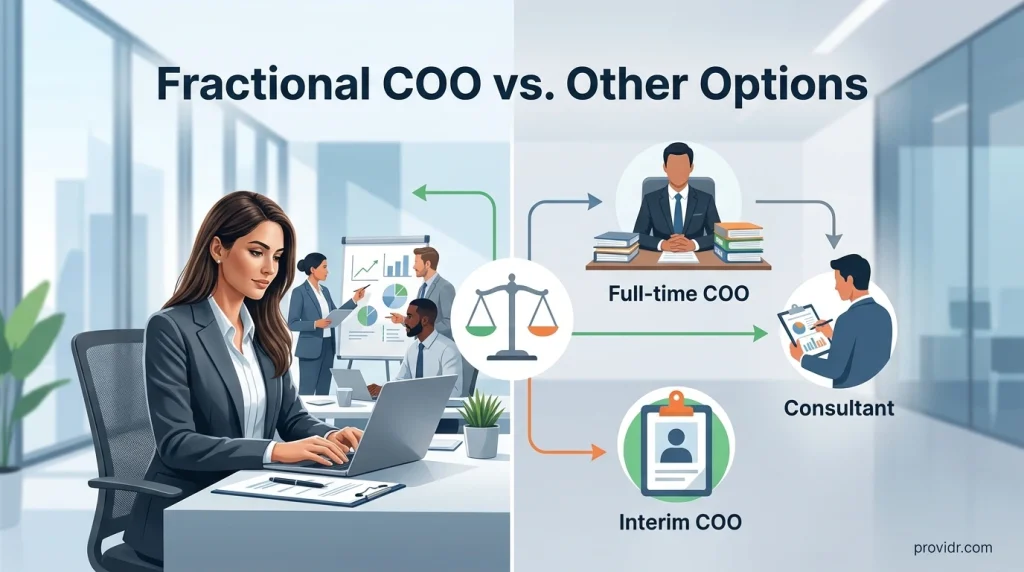
Founders often confuse a fractional COO with a consultant, coach, or operations manager. Here’s how they differ.
| Role | Time Commitment | Typical Focus | Best For |
| Fractional COO | Part-time, ongoing (1–3 days/week) | Hands-on execution and leadership of operations | Companies needing senior operational leadership without full-time cost |
| Full-Time COO | 100%, permanent | Deep, continuous ownership of all operations | Larger companies with steady, complex operational needs |
| Operations Consultant | Project-based, short-term | Diagnosing problems, delivering recommendations | Companies that need a specific fix, not ongoing leadership |
| Business Coach | Periodic sessions | Advising the founder, not executing directly | Founders who want guidance but will implement changes themselves |
| Operations Manager | Full-time, typically junior-mid level | Day-to-day task execution | Companies that already have strategic direction and need someone to run it |
Here’s the key difference. A consultant tells you what to do. A coach helps you think it through. A fractional COO actually does the work alongside your team.
Key Benefits of a Fractional COO
- Lower cost than a full-time hire. You get senior-level expertise without a six-figure salary, benefits, and equity.
- Faster impact. Experienced fractional COOs have usually solved similar problems before. They move quickly instead of learning on the job.
- Flexibility. You can scale the engagement up or down as your needs change.
- Objectivity. As an outsider, they spot inefficiencies and blind spots that your own staff often miss or avoid raising.
- Reduced founder burnout. Freeing the CEO from daily operations lets them focus on growth, sales, and vision.
- Stronger investor and buyer confidence. Clean, documented operations make the business more attractive during fundraising or a sale.
Limitations and Drawbacks
No solution is perfect. A fractional COO isn’t right for every business. Common limitations include:
- Limited availability. Because they split time across clients, they may not respond as fast to urgent, same-day issues as a full-time hire would.
- Less institutional knowledge. It takes time for anyone part-time to fully learn your culture and history.
- Not a fit for very early-stage startups. If you have fewer than five employees and minimal revenue, you may not have enough operational complexity to justify the cost yet.
- Requires trust and delegation. Founders who struggle to let go of control often get less value from the arrangement.
- Not a permanent fix for every company. Businesses with continuous, complex operational needs eventually outgrow a part-time arrangement. They need a full-time COO.
Read More: https://providr.com/accessibility-debt-is-more-expensive-than-technical-debt/
Cost of a Fractional COO

Pricing varies by experience, industry, and engagement structure. Most fractional COOs charge one of three ways:
| Pricing Model | Typical Range | Notes |
| Monthly retainer | $4,000–$15,000/month | Most common structure; scales with days per week committed |
| Hourly rate | $150–$350/hour | Common for smaller, project-based needs |
| Day rate | $1,200–$2,500/day | Used for one or two set days per week |
Compare that to a full-time COO. Their salary typically runs $180,000–$350,000 a year, plus benefits, bonuses, and often equity. Most businesses find that a fractional COO delivers 70–80% of the strategic value at a fraction of the annual cost. That’s exactly why the model has grown so popular among small and mid-sized companies.
How to Choose the Right Fractional COO: A Decision Framework
Not every fractional COO fits every business. Use these criteria to evaluate candidates:
1. Industry and stage experience. Have they worked with companies your size, in your industry, facing similar challenges?
2. Track record with measurable outcomes. Ask for specific examples, like reduced costs, improved margins, or successful launches. Don’t settle for vague claims of “helping operations.”
3. Communication style and cultural fit. They’ll work closely with your team. Personality and communication style matter as much as credentials.
4. Scope clarity. A strong fractional COO defines exactly what they will and won’t own. They won’t overpromise.
5. References from past clients. Always speak with at least two previous clients about results and working style.
6. Exit plan. Ask how they typically transition out or hand off responsibilities, especially if you plan to hire full-time eventually.
Quick Decision Checklist
- [ ] They’ve worked with businesses similar in size and industry
- [ ] They can share specific, measurable results from past engagements
- [ ] Their communication style matches how your team operates
- [ ] They’ve clearly outlined scope, deliverables, and timeline
- [ ] Past clients confirm strong results and professionalism
- [ ] Pricing fits your budget without compromising quality
Common Mistakes to Avoid
- Hiring too early. Bringing in a fractional COO before you have real operational complexity often means paying for expertise you don’t need yet.
- Not defining priorities upfront. Without clear goals, engagements drift. Results become hard to measure.
- Treating them like a consultant. A fractional COO should be embedded in execution, not just handing you a report and walking away.
- Failing to introduce them properly to the team. If staff don’t understand their authority, implementation stalls.
- Choosing based on price alone. The cheapest option is rarely the best value if it doesn’t solve your actual problem.
- Skipping reference checks. Past performance is one of the strongest predictors of future results.
Best Practices for Working with a Fractional COO

- Set clear, written expectations and KPIs from day one
- Give them real decision-making authority, not just advisory input
- Schedule consistent check-ins, even during weeks when they’re not on-site
- Involve them in leadership meetings so they understand strategic context
- Review progress every 90 days and adjust priorities as needed
- Plan early for what happens after the engagement, whether that’s a full-time hire or a longer fractional relationship
Real-World Example: How This Plays Out
Consider a composite example based on common patterns across growing service businesses. A marketing agency grows from 8 to 35 employees in under two years. Revenue doubles. But profit margins shrink because there’s no consistent process for project handoffs, resourcing, or client onboarding. The founder works nights just to keep client deliverables on track.
A fractional COO comes in for two days a week. In the first month, they map out every workflow from lead to delivery. They find that project delays come from unclear handoffs between sales and delivery teams. Over the next quarter, they build a standardized onboarding process, introduce a project management system, and set clear KPIs for each department.
Within six months, project delivery times drop by 30%. The founder reclaims roughly 20 hours a week. They redirect that time into sales and partnerships, which drives further growth. This kind of outcome is typical of what a well-matched fractional COO engagement can deliver.
Fractional COO vs. Fractional CEO vs. Fractional CFO
Businesses sometimes need more than operational help. Here’s how these fractional roles differ:
| Role | Primary Focus | When You Need One |
| Fractional COO | Operations, systems, execution | Growth has outpaced internal processes |
| Fractional CEO | Overall strategy, vision, leadership | Founder needs to step back or company needs interim top leadership |
| Fractional CFO | Financial strategy, forecasting, fundraising | Company needs stronger financial planning or is raising capital |
Many growing companies start with a fractional COO first. Operational bottlenecks are usually the most immediate and visible problem. CFO and CEO support often follow as the business scales further.
FAQs
How many hours a week does a fractional COO typically work? Most engagements run one to three days per week. This can flex up during critical projects, like a product launch or funding round, and scale down once systems stabilize.
Can a fractional COO become a full-time employee later? Yes. This is common. Many companies start fractional to test fit and value. They convert the role to full-time once the business has enough operational volume to justify it.
What size company typically needs a fractional COO? Most fractional COOs work with companies from $1 million to $30 million in annual revenue, though this varies. The key factor isn’t revenue alone. It’s operational complexity.
Is a fractional COO the same as an interim COO? No. An interim COO usually fills a full-time role temporarily, often during a leadership transition. A fractional COO works part-time on an ongoing basis, often across multiple clients at once.
How quickly will I see results after hiring one? Most businesses see initial process improvements within 60 to 90 days. Larger structural changes, like reorganizing teams or overhauling reporting systems, typically take three to six months.
Do fractional COOs work remotely or in person? Both models exist. Many engagements are hybrid. They combine periodic in-person time for leadership meetings with remote work for day-to-day execution.
What industries benefit most from fractional COOs? They’re common in professional services, SaaS, e-commerce, healthcare practices, manufacturing, and agencies. Essentially, any business facing rapid growth or operational strain can benefit.
How is a fractional COO different from a general business consultant? A consultant typically diagnoses problems and hands over recommendations. A fractional COO stays embedded in the business. They implement changes and manage execution directly alongside your team.
What happens if the fractional COO isn’t a good fit? Most contracts include a defined trial period or a 30–60 day notice clause. This lets either party exit cleanly if the engagement isn’t delivering value.
Should I hire a fractional COO or promote from within? It depends on whether someone internally already has senior operational experience. If not, a fractional COO can build the systems and mentor an internal successor. That creates a smoother long-term transition than promoting someone without that background.
Key Takeaways
A fractional COO gives growing businesses access to senior operational leadership without the cost of a full-time executive hire. The model works best for companies that have outgrown their current systems but aren’t ready yet, financially or operationally, for a full-time COO.
Before you hire one, get clear on your specific pain points. Set measurable goals. Vet candidates carefully using their track record, communication style, and industry experience. Done right, a fractional COO doesn’t just fix operational chaos. They free you to focus on the parts of the business only you can lead: vision, strategy, and growth.
If you’re stuck managing every detail instead of steering the company forward, that’s usually the clearest sign it’s time to start the conversation.