
My Son Can’t See Colors: How Do I Explain Colors to a Color-Blind Child?
If you just found out your son is color blind, take a breath. You are not alone, and this is not a crisis. Color blindness, also called color vision deficiency (CVD), is common. It affects about 1 in 12 boys. Most children with CVD grow up healthy, happy, and successful. The short answer to your question My Son Can’t See Colors: How Do I Explain Colors to a Color-Blind Child?: explain colors using words, textures, positions, and patterns instead of relying only on the color name. Teach him that “grass is green” the same way you’d teach a fact, like “dogs bark.” He will learn to trust labels and context, even if his eyes see the color differently than yours.
This guide walks you through everything else. You’ll learn what color blindness really is, how your son experiences the world, and how to teach, support, and advocate for him at home and school.
What Is Color Blindness (Color Vision Deficiency)?
Color blindness is a condition where the eyes have trouble telling certain colors apart. It’s not actual blindness. Your son can see just fine. His eyes simply process color differently.
Inside the eye, special cells called cone cells detect color. Most people have three types of cones. Each one picks up a different range of light: red, green, or blue. Color blindness happens when one or more of these cones is missing, weak, or works differently than expected.
This condition is almost always genetic. It’s passed down through the X chromosome, which is why it’s far more common in boys than girls.
Read more: https://providr.com/how-to-make-transactions-on-my-metatrader-5-a-beginners-step-by-step-guide/
Common Types of Color Blindness
| Type | What Happens | How Common |
| Deuteranomaly | Green cones work weakly | Most common type, mostly mild |
| Protanomaly | Red cones work weakly | Common, mild to moderate |
| Protanopia | No red cone function | Less common, more severe |
| Deuteranopia | No green cone function | Less common, more severe |
| Tritanomaly/Tritanopia | Blue-yellow confusion | Rare |
| Achromatopsia | No color vision at all | Very rare |
Most color-blind children have red-green color vision deficiency. This means they mix up colors like red and green, or brown and green, rather than seeing the world in black and white.
How Do Color-Blind Children Actually See the World?
This is the part most parents get wrong. Your son does not see in gray. He sees color. He just sees fewer distinct shades than you do.
Colors that look very different to you, like red and green, may look similar to him. He may also struggle with pastel shades or dark colors that blend together, like navy blue and black, or brown and dark green.
Think of it less like “missing color” and more like a smaller color vocabulary in his eyes. He can still enjoy a sunset or a rainbow. He just won’t describe it the way you do.
Read more: https://providr.com/best-au-pair-programs-in-the-us/
Myths Parents Should Stop Believing
- Myth: He sees only black, white, and gray. False. Total color blindness (achromatopsia) is extremely rare.
- Myth: It will get worse over time. Inherited color blindness usually stays stable for life.
- Myth: He can’t play sports, drive, or pick a career. Most color-blind people live completely normal lives. Some careers have restrictions, like pilot or electrician, but most jobs are open to him.
- Myth: It’s something you did wrong during pregnancy. It’s genetic, not caused by anything a parent did.
- Myth: Glasses will “fix” it. Color-correcting glasses can help with contrast, but they don’t cure color blindness.
- Myth: Only boys can be color blind. Girls can be color blind too, though it’s rarer.
Early Signs of Color Blindness in Children
Many parents notice something is off long before a diagnosis. Watch for these signs:
- He colors grass purple or the sky green, and insists he’s right
- He struggles to match socks or clothes by color
- He mixes up red and green crayons or markers
- He has trouble with color-coded worksheets in preschool or kindergarten
- He calls two clearly different colors by the same name
- Teachers mention he avoids coloring activities or gets frustrated with them
- He does great with shapes, letters, and numbers, but colors seem to confuse him specifically
One sign alone doesn’t confirm anything. But a pattern of these signs is worth a professional check.
When to Seek Professional Testing
Ask your pediatrician or an eye doctor (optometrist or ophthalmologist) for a color vision test if:
- He’s between 4 and 6 years old, since this is when color-based schoolwork increases
- A teacher raises concerns about color confusion
- There’s a family history of color blindness, especially on the mother’s side
- You’ve noticed two or more early signs listed above
Many schools and pediatricians now recommend a simple color vision screening around age 4 or 5, before formal schooling ramps up color-dependent tasks.
How Diagnosis Usually Works
Diagnosis is quick, painless, and non-invasive. The most common method is the Ishihara test, where your son looks at circles made of colored dots and tries to spot a number or shape hidden inside. Doctors may also use the HRR test or Farnsworth D-15 test for more detail, especially with younger children who can’t read numbers yet, using shapes or animals instead.
A full diagnosis will tell you the type and severity of his color vision deficiency. This information is genuinely useful. It helps you and his teachers know exactly which colors cause confusion.
How to Explain Colors to a Color-Blind Child: Step-by-Step
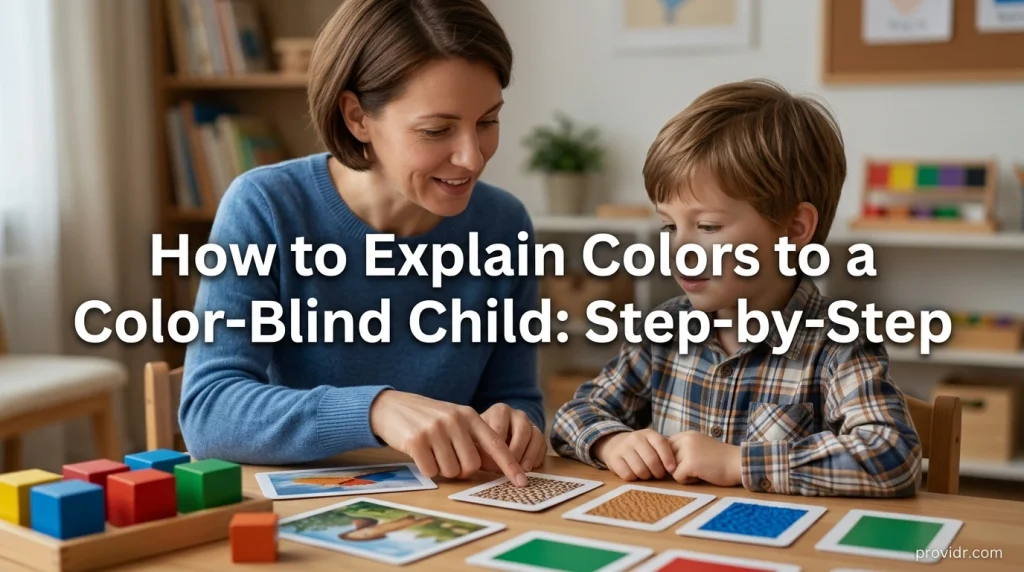
Once you understand his diagnosis, you can start teaching in a way that builds confidence instead of confusion of My Son Can’t See Colors: How Do I Explain Colors to a Color-Blind Child?
Step 1: Normalize It Before You Teach It
Start with a simple, honest conversation. Something like: “Your eyes see colors a little differently than mine. That’s not wrong, it’s just how your eyes work. Lots of people see colors this way.” This removes shame before any lesson begins.
Step 2: Teach Color as a Fact, Not a Perception
Instead of asking “what color is this?” and correcting him when he’s wrong, teach color the way you’d teach a fact he can’t observe directly, like “the sun is very hot.” Say: “Bananas are yellow. That’s just their name.” Repetition builds the fact into memory, even without matching perception.
Step 3: Use Position and Context Clues
Many colors are predictable by what they’re attached to. Teach him:
- The sky is always “up,” so up-blue is sky-blue
- Grass and leaves are usually “down,” so down-green is grass-green
- Fire trucks, stop signs, and stop lights are red
- Bananas are yellow, oranges are orange, grapes are purple
This turns color into a memory game he can win, not a test he keeps failing.
Step 4: Use Textures, Shapes, and Patterns Instead of Color Alone
When teaching or organizing, pair color with a non-color feature:
- Use different shaped labels for different colors (a star for red, a circle for blue)
- Use textured stickers on crayons or markers (a bump for green, a dot for red)
- Label toy bins with both color and a picture, like a red bin with a picture of a fire truck
Step 5: Tell Stories with Color
Kids remember stories better than facts. Try: “The grumpy red dragon breathes fire, and the sleepy green dragon naps in the grass.” Repetition of these characters helps color names stick through story memory, not visual matching.
Step 6: Use Real Objects, Not Just Flashcards
Flashcards isolate color with no context, which is the hardest way for a color-blind child to learn. Real objects give texture, size, and shape as extra clues. A ripe strawberry is easier to remember as “red” than a plain red square on a card.
Step 7: Avoid Correcting in Front of Others
If he says the wrong color in a group setting, gently confirm the right answer without drawing attention to the mistake. Public correction chips away at confidence fast. Private, calm correction works better.
Step 8: Label Everything at Home
Use color-coded labels with words written on them, not just color swatches. Crayons, markers, folders, and clothing all benefit from a written label alongside the color.
Step 9: Practice with Color Vision Apps and Games
Several free apps and games are designed specifically for color-blind children. These let him practice color recognition using their name, position, and pattern, all reinforced through play instead of pressure.
Step 10: Celebrate Progress, Not Perfection
Track small wins. If he correctly names five reds in a row this week versus three last week, celebrate that. Progress builds confidence far better than chasing perfect accuracy.
Supporting Learning at Home
Choosing Educational Toys and Books for a Color-Blind Child
| Good Choices | Why They Work |
| Shape-sorting toys | Focus on shape, not color, matching |
| Textured puzzles | Add a non-visual clue to each piece |
| Labeled art sets | Words plus color reduce guesswork |
| Story books with strong characters | Memory hooks beyond color alone |
| Pattern-matching games | Builds visual skills that don’t depend on color |
Avoid toys that rely entirely on color-matching with no other distinguishing feature, like plain colored blocks with no shapes, labels, or textures.
Art Projects at Home
Art doesn’t need to be stressful. Try these adjustments:
- Label paint bottles and crayons with the color name written on them
- Let him choose colors freely instead of following a strict color key
- Praise creativity and technique over “correct” color choices
- Use color-coded stickers only when paired with a written label
Digital Devices and Screen Settings
Most smartphones, tablets, and computers now include a built-in color correction or color filter setting for color vision deficiency. These filters shift colors on screen to make them easier to distinguish. They’re free, built-in, and worth turning on for games, apps, and schoolwork done on a screen.
Communicating with Teachers and Supporting School Life
How to Talk to Your Son’s Teacher
Send a short, clear note or have a quick meeting. Include:
- His diagnosis and type of color blindness
- Which colors are hardest for him to distinguish
- A request to avoid relying only on color-coded instructions
- A request to avoid public correction if he answers a color question wrong
Most teachers appreciate this information. It helps them adjust worksheets, seating, and classroom materials without singling him out.
Adapting School Activities
- Ask teachers to add labels or patterns to color-coded charts, graphs, and maps
- Request seating near the front for whiteboard activities that use colored markers
- Suggest black-and-white or high-contrast printed worksheets instead of color-coded ones
- Ask that verbal instructions accompany any color-based instructions (“the red group” becomes “the red group, on the left side”)
Helping Him Build Confidence in Social Situations
Kids can be blunt about differences. Prepare him with a simple, confident response he can use if a classmate questions his color choices: “My eyes see colors a little differently, that’s all.” Practicing this line at home means he won’t be caught off guard at school.
Everyday Life: Clothing, Homework, and Routines

Clothing and Getting Dressed
- Organize his closet by outfit, not by color, so matching isn’t a daily struggle
- Label drawers or hangers with color names
- Let him pick clothes freely on non-important days to build independence
- Lay out planned outfits the night before school photos or events
Homework and Color-Coded Materials
Color-coded folders, highlighters, and charts are everywhere in school. Swap these for:
- Labeled folders (written word plus a shape or pattern)
- Number-coded or letter-coded systems instead of color-only systems
- Textured or patterned highlighters instead of color-only ones
Daily Routines That May Be Challenging
| Routine | Common Struggle | Simple Fix |
| Picking out clothes | Matching colors | Label drawers, pre-plan outfits |
| Coloring homework | Wrong color choice | Written labels on crayons |
| Traffic lights | Red-green confusion | Teach light position (top, middle, bottom) |
| Sports team colors | Mixing up teams | Focus on jersey number or pattern |
| Reading color-coded maps | Confusing regions | Ask for labeled or textured maps |
Do Color-Blind Glasses and Assistive Tools Actually Help?
This is one of the most common questions parents search for, so let’s be direct.
What they can do: Color-correcting glasses, like those from EnChroma or similar brands, adjust how certain wavelengths of light reach the eyes. For some people with red-green color vision deficiency, this increases contrast between colors, making them easier to tell apart.
What they cannot do: These glasses do not cure color blindness. They don’t give a color-blind eye new cone function. They don’t work the same for everyone. Some children notice a real difference. Others notice little to no change. Results vary by the type and severity of the color vision deficiency.
Is there a cure? No. There is currently no routine, approved cure for inherited color blindness. Gene therapy research exists, but it isn’t a mainstream medical treatment yet. Any claim of a permanent “fix” should be treated with skepticism.
If you’re considering glasses, talk to an eye doctor first, and treat them as an optional tool, not a required fix. Many color-blind children live full, confident lives without ever using them.
Common Mistakes Parents Make
- Quizzing him repeatedly on colors to “test” his memory, which builds anxiety
- Correcting him in front of friends, family, or classmates
- Assuming he’s not paying attention or not trying, when it’s a vision issue
- Relying only on flashcards instead of real-world context
- Waiting too long to get a professional diagnosis
- Hiding the diagnosis instead of explaining it simply and calmly
- Comparing his color skills to a sibling’s
Emotional Support Strategies for Parents

A color vision diagnosis is not a loss. It’s information that helps you support him better. Still, it’s normal to feel a mix of worry, guilt, or uncertainty. Here’s how to manage that, for both of you:
- Talk about it openly and matter-of-factly, without making it a big, heavy topic
- Let him ask questions, and answer them honestly and simply
- Point out that many successful, famous people are color blind
- Avoid framing color blindness as a disability that limits his future
- Watch your own tone. Kids pick up on parental anxiety quickly.
- Give him language to explain it to others so he feels in control of his own story
Actionable Checklist for Parents
- Schedule a color vision test if you haven’t already
- Ask for the specific type and severity of his color blindness
- Talk to his teacher and request simple classroom adjustments
- Label crayons, markers, and clothing at home
- Replace color-only systems with labeled or patterned ones
- Turn on color correction settings on his devices
- Practice a confident explanation he can use with peers
- Choose toys and books that don’t rely only on color-matching
- Celebrate small wins in color learning, without pressure
- Revisit testing every few years to track any school-related needs
FAQs
Is color blindness in boys more common than in girls? Yes. Because the gene is carried on the X chromosome, boys are far more likely to be color blind than girls. About 1 in 12 boys has some form of color vision deficiency, compared to about 1 in 200 girls.
Can color blindness be cured? No. Inherited color blindness has no approved cure right now. Color-correcting glasses and screen filters can help with contrast, but they don’t restore normal cone function.
Will my son’s color blindness get worse as he grows? Inherited color blindness typically stays the same throughout life. It doesn’t usually get worse or better with age.
Can a color-blind child still enjoy art and drawing? Absolutely. Many color-blind people are talented artists. Color blindness affects color perception, not creativity, technique, or artistic skill.
How do I know which colors are hardest for my son? A color vision test will tell you his exact type of color blindness. Red-green confusion is most common, but a professional test gives you specifics you can share with teachers.
Should I tell his school even if it seems minor? Yes. Even mild color vision deficiency can affect how he interprets color-coded worksheets, charts, and classroom materials. A quick note to his teacher prevents unnecessary confusion or frustration.
Are there jobs my color-blind son won’t be able to do later in life? A small number of careers, like commercial pilot or certain military and electrical roles, have color vision requirements. Most careers, including many in science, art, business, and technology, are completely open to color-blind individuals.
Do color-blind glasses work for every type of color blindness? No. They tend to help most with red-green color vision deficiency and results vary by person. They don’t work as well, or at all, for more severe or rare types like achromatopsia.
At what age can color blindness be reliably tested? Most children can be reliably tested from around age 4, using picture or shape-based versions of standard tests instead of number-based ones.
Is my son at any higher risk for other vision problems because he’s color blind? No. Inherited color blindness is a standalone condition. It doesn’t increase the risk of other eye diseases or vision problems on its own.
A Final, Reassuring Word
Your son’s color blindness is a small piece of who he is, not a barrier to who he’ll become. With clear, patient teaching and a few simple adjustments at home and school, he’ll learn colors just fine, in his own way.
The most powerful thing you can give him isn’t a perfect color vocabulary. It’s confidence. Talk about his vision openly, keep lessons pressure-free, and let him know his eyes work differently, not wrongly.
If you haven’t already, book that color vision test, share the results with his teacher, and start using the labeling and storytelling tips above this week. Small, steady steps now will make color a non-issue for him later.